Natural Resources Conservation Service
Conservation Innovation Grant
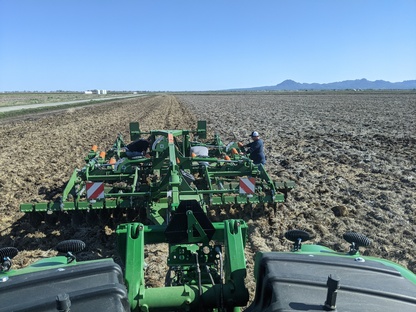
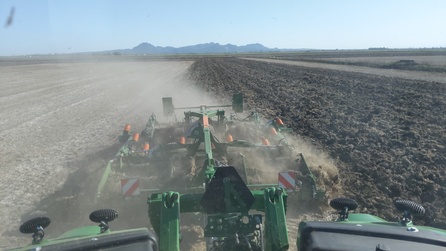
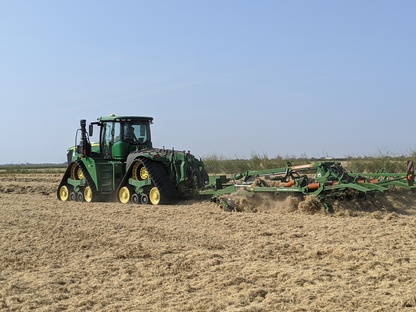
We partnered with Natural Resources Conservation Service under a Conservation Innovation Grant to conduct field research to evaluate the potential of reduced spring tillage for California rice farming systems. The project focused on the feasibility of the Amazone Ceus-2TX trailed disc harrow cultivator combination in California rice farming operations.
Outcomes:
- We successfully used the tool for two years to reduce 2 tractor tillage passes in the spring to plant medium grain sushi rice while maintaining yield. The new tool allowed for the lowering of particulate matter from tillage, minimized fuel usage, reduced NOx emissions from tractor engine time in the field, and conserved deep soil moisture by decreasing tillage time for seed bed preparation – compared to traditional tillage in the region.
- We demonstrated that reduced tillage in California Rice production can maintain yields, and in our case produce yield above industry average while reducing inputs and conserving natural resources. Over the course of three on-farm field trials over 2 years, we successfully maintained yields under reduced tillage management, confirming the agronomic viability of these practices at the commercial scale. Our on farm trail was benchmarked with a University of California Cooperative Extension (UCCE) Statewide Yield Tests within our field, where production yields were consistent or above state averages.
The values of reduced tillage in Calfiornia have been clear and measurable:
- Maintaining yields while reducing tractor passes, equipment hours, and input costs.
- Reducing diesel fuel use and emissions by eliminating multiple tillage operations.
- Conserving deep soil moisture to reduce irrigation water use.
- Saving labor and time, freeing up employees and family members for other critical farm tasks.
Our family is excited that we can have
50% reduction in spring tillage while maintaining rice yields!
Future -
Even though this grant has ended, the momentum has not. We are committed to working with our local University of California Cooperative Extension and fellow farmers through a peer learning platform to expand conservation tillage on the farm with drill seeded rice, with the goal of improving conservation, economics, and rice production. What began as a single rented tool has evolved into a farm-wide transformation, underpinned by investment in new equipment, changes in cultural practices, and a mindset of continuous improvement.
Conclusion -
The outcomes of this NRCS CIG project have not only met, but far exceeded, our expectations. This grant gave us permission to take risks, confidence to dream, and the support to make those dreams a reality. The result is a more resilient and sustainable farming operation that we are proud to share as a model with other rice producers.
As agriculture continues to face market pressures and environmental challenges, programs like the Conservation Innovation Grant are vital. We hope that NRCS will continue to provide these opportunities for family farmers. They allow producers like us to test new technologies, adapt practices, reduce input costs, and safeguard the future of family farming while conserving the precious natural resources on which we all depend.
We extend our deepest gratitude to NRCS for planting the seed of innovation on our farm. The fire that began with this grant will continue to guide our family as we adapt, improve, and ensure the sustainability of our operation for generations to come.